I haven't read it all yet but this is not a strict liability offence in any sense. The court is looking for excuses to keep this pathetic law alive. Absolute liability generally applied to regulatory offences, such as speeding. R. v Sault Ste. Marie recognized the need for and existence of an intermediate category of strict liability offences for public welfare offences, such as environmental or equipment related. http://en.wikipedia.org/wiki/R._v._City ... _Ste-Marie http://canlii.org/en/ca/scc/doc/1978/19 ... lii11.html Strict lability offences are found in the Equipment Section under Part VI of the Act, and which regulates things such as lamps on vehicles; lighted streets; possession of red lights on vehicles; visibility of lights; brakes; windshield wipers; mirrors; speedometers; safety glass; mufflers; alarm bells; televisions in vehicles; and various others. The justice in this case claims its the punishment that dictates whether or not it is a strict or absolute liability offence. What a dumbass. His ruling flies in the face of the Supreme Court case BC Motor Vehicle Act 1995. http://csc.lexum.umontreal.ca/en/1985/1 ... 2-486.html If the punishment dictated which class of offence it was then the BC Motor Vehicle Act case wouldve been determined to be a strict liability offence because a term of imprisonment was attached. It was not a strict liability but an absolute liability offence. Even if you look at the punishment language in s. 172(2) it states; Offence (2) Every person who contravenes subsection (1) is guilty of an offence... This is not language depicting a due diligence defence offence. It depicts an absolute liability offence only allowing the accused to challenge the evidence; but does not allow the accused to provide a defence to the offence. You are guilty upon the act of committing the offence. Courts have determined offences employing the "no person shall" or "every driver shall" formulation are interpreted as absolute liability offences: R. v. Hickey (1976), 13 O.R. (2d) 228. (speeding) R. v. Kurtzman (1991), 66 C.C.C. (3d) 161 at 172 (Ont. C.A.)-(failing to stop at a red light) and London (City) v. Polewsky (2005), 202 C.C.C. (3d) 257 (Ont. C.A. )-(speeding). Section 172 states; Racing, stunts, etc., prohibited 172. (1) No person shall drive a motor vehicle on a highway in a race or contest, while performing a stunt or on a bet or wager. Ms. Carter also incorrectly states that s. 128 provides for higher penalties than s. 172. Duh! After declaring s. 172 to be a strict liability offence, the justice than failed to inquiry whether or not the driver had an excuse to be speeding, i.e., the due diligence defence, before imposing his punishment. In the regulation for s. 172 it also uses the term marked departure. Sectio 2(2) expressly states; (2) In this section, "marked departure from the lawful rate of speed" means a rate of speed that may limit the ability of a driver of a motor vehicle to prudently adjust to changing circumstances on the highway. If a driver can only be charged for a stunt when he's doing 50 kms over the speed limit, how can a driver be charged for racing or contest if he's doing less than 50 kph over? A marked departure only applies to the race contest offence. Going 50 kms over is clearly a marked departure from the lawful rate of speed, but the marked departure doesn't apply to he stunt offence. Therefore, a marked departure indicates the race contest is a mens rea offence, not a strict liability offence as the justice incorrectly ruled. The race contest offence is no different han the street racing offence in the Criminal Code, which is also a mens rea offence. The crown must prove the actus reus beyond a reasonble doubt and the mens rea beyond a reasonable doubt. The stunt offence is an absolute liability offence and does not require mens rea or provide for a due diligence defence. http://csc.lexum.umontreal.ca/en/2008/2 ... 8scc5.html
I haven't read it all yet but this is not a strict liability offence in any sense. The court is looking for excuses to keep this pathetic law alive.
Absolute liability generally applied to regulatory offences, such as speeding. R. v Sault Ste. Marie recognized the need for and existence of an intermediate category of strict liability offences for public welfare offences, such as environmental or equipment related.
http://en.wikipedia.org/wiki/R._v._City ... _Ste-Marie
http://canlii.org/en/ca/scc/doc/1978/19 ... lii11.html
Strict lability offences are found in the Equipment Section under Part VI of the Act, and which regulates things such as lamps on vehicles; lighted streets; possession of red lights on vehicles; visibility of lights; brakes; windshield wipers; mirrors; speedometers; safety glass; mufflers; alarm bells; televisions in vehicles; and various others.
The justice in this case claims its the punishment that dictates whether or not it is a strict or absolute liability offence. What a dumbass. His ruling flies in the face of the Supreme Court case BC Motor Vehicle Act 1995.
http://csc.lexum.umontreal.ca/en/1985/1 ... 2-486.html
If the punishment dictated which class of offence it was then the BC Motor Vehicle Act case wouldve been determined to be a strict liability offence because a term of imprisonment was attached. It was not a strict liability but an absolute liability offence.
Even if you look at the punishment language in s. 172(2) it states;
Offence
(2) Every person who contravenes subsection (1) is guilty of an offence...
This is not language depicting a due diligence defence offence. It depicts an absolute liability offence only allowing the accused to challenge the evidence; but does not allow the accused to provide a defence to the offence. You are guilty upon the act of committing the offence.
Courts have determined offences employing the "no person shall" or "every driver shall" formulation are interpreted as absolute liability offences: R. v. Hickey (1976), 13 O.R. (2d) 228. (speeding) R. v. Kurtzman (1991), 66 C.C.C. (3d) 161 at 172 (Ont. C.A.)-(failing to stop at a red light) and London (City) v. Polewsky (2005), 202 C.C.C. (3d) 257 (Ont. C.A. )-(speeding).
Section 172 states;
Racing, stunts, etc., prohibited
172. (1) No person shall drive a motor vehicle on a highway in a race or contest, while performing a stunt or on a bet or wager.
Ms. Carter also incorrectly states that s. 128 provides for higher penalties than s. 172. Duh!
After declaring s. 172 to be a strict liability offence, the justice than failed to inquiry whether or not the driver had an excuse to be speeding, i.e., the due diligence defence, before imposing his punishment.
In the regulation for s. 172 it also uses the term marked departure. Sectio 2(2) expressly states;
(2) In this section,
"marked departure from the lawful rate of speed" means a rate of speed that may limit the ability of a driver of a motor vehicle to prudently adjust to changing circumstances on the highway.
If a driver can only be charged for a stunt when he's doing 50 kms over the speed limit, how can a driver be charged for racing or contest if he's doing less than 50 kph over?
A marked departure only applies to the race contest offence. Going 50 kms over is clearly a marked departure from the lawful rate of speed, but the marked departure doesn't apply to he stunt offence.
Therefore, a marked departure indicates the race contest is a mens rea offence, not a strict liability offence as the justice incorrectly ruled. The race contest offence is no different han the street racing offence in the Criminal Code, which is also a mens rea offence.
The crown must prove the actus reus beyond a reasonble doubt and the mens rea beyond a reasonable doubt.
The stunt offence is an absolute liability offence and does not require mens rea or provide for a due diligence defence.
http://csc.lexum.umontreal.ca/en/2008/2 ... 8scc5.html



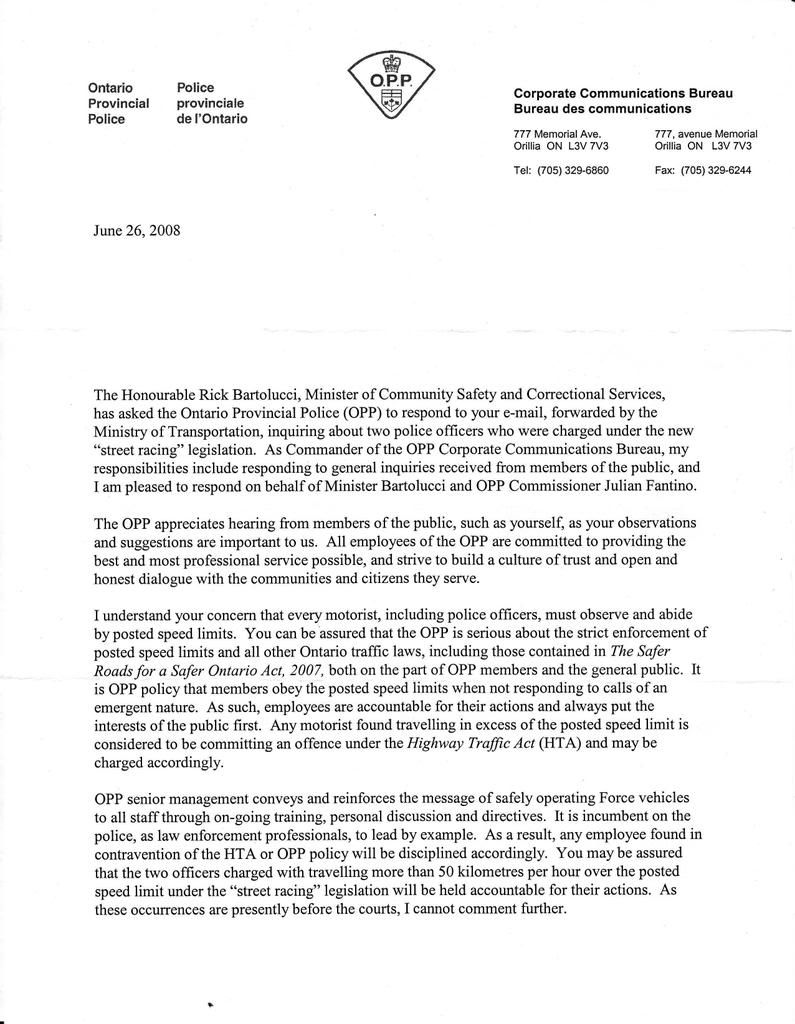





 California: "exhibition of speed" = possible jail time and PERMANENT confisciation of your vehicle!!! Difference? Oh yeah, all of that is AFTER you get convicted!